 info@credit-essense.com
 (816) 839-4020

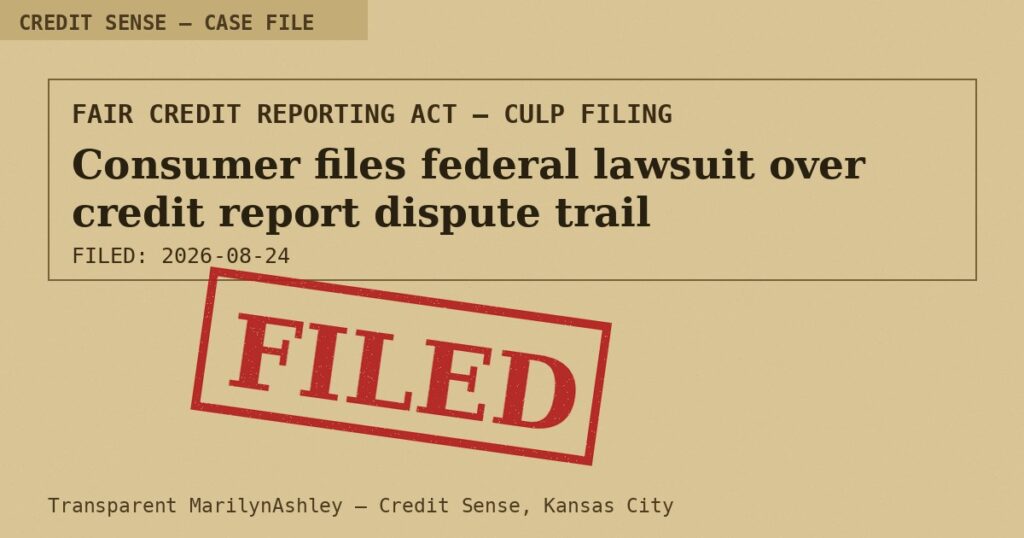
A Consumer Sues Upgrade and CBW Bank Over His Credit File
Yall, a new court filing landed on August 24, 2026, and I want to be careful with this one from the start... this is a lawsuit that was filed, not a decision that was made.
Plaintiff Lamonte Culp filed a case in federal court against Upgrade, Inc. and CBW Bank. The docket number listed by Justia is 0:2026cv03642. The cause of action listed is 15 U.S.C. section 1681, the Fair Credit Reporting Act, often called the FCRA.
That is what the public docket listing tells us. It does not tell us that either company did anything wrong.
A filing is not a finding
Justia carries its own disclaimer on docket listings, and it matters here. Docket listings are public litigation records and should not be treated as findings of fact or liability.
In plain English, a complaint is one side telling a court its story and asking the court to hear it. The companies named get to respond. A judge has not ruled in this listing, and no finding of liability has been made.
So why write about a filing at all? Because ordinary people do end up in federal court over a credit file. That rarely happens on day one. It usually follows a long paper trail of disputes and responses that did not fix the file.
I am not going to fill in facts the docket does not give us. We do not have, from this listing, the specific account or the specific error alleged. Inventing those details would not be honest.
The steps that come before a lawsuit
Most credit report problems start much smaller, and that is good news for you. The FCRA gives you the right to dispute information you believe is inaccurate with the credit bureau that issued the report, and with the company that furnished the information.
A strong dispute is specific. It names the account exactly as it appears, points to the exact field that is wrong, states what the correct information should be, and encloses copies of documents that support you.
Then you keep everything. The letter. The copies. The mailing receipt if you send it by a trackable method. The bureau response. Your notes from any phone call, with the date and the name of the person you spoke with.
That paper trail does two jobs. It gives the bureau and the furnisher a clear chance to correct the record. And if the error stays, it shows what you asked for, when you asked, and what happened next.
Here is the order I teach my clients:
- Pull your reports and circle the exact wrong field before you write anything.
- Write a specific dispute to the bureau that issued that report.
- Send copies of supporting documents, never your originals.
- Keep a copy of the complete packet and calendar the response.
- Check the report again after the investigation and save the new version.
Real raw truths about credit files
A credit file can feel invisible until it costs you something. A denial. A higher rate. That is when people learn the file has been speaking for them, whether it was accurate or not.
You do not need a lawsuit to protect yourself. You need your reports, a pen, and the discipline to keep copies. Read the file. Find the exact error if there is one. Dispute it in writing. Keep proof.
If a company corrects it, you have a cleaner record. If it does not, you have built the record any next step depends on.
That is the lesson in an August 24 filing with very few public details. The court will handle the claims. Your job, starting today, is simpler... make sure your own paper trail is ready before you ever need it.
— Marilyn Ashley, Credit Sense (Kansas City)