 info@credit-essense.com
 (816) 839-4020

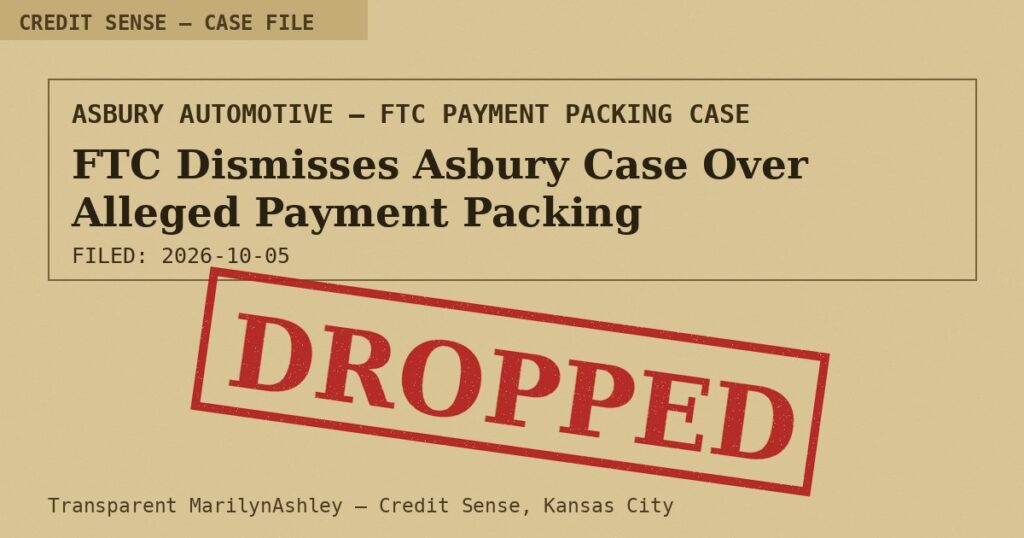
FTC Dismisses Its Asbury Automotive Payment Packing Case
Yall, a federal case ending is not the same thing as a federal case being won... and this one ended with no ruling at all. On October 5, 2026, the Federal Trade Commission dismissed its complaint against Asbury Automotive Group. There was no ruling on the merits, and no refunds were ordered in that case. I need yall to hear those two facts first, because the headline alone does not tell the whole story.
The original complaint was filed in August 2024. It named Asbury Automotive Group, three Texas dealerships, and a general manager. The dealerships were David McDavid Ford in Fort Worth, David McDavid Honda of Frisco, and David McDavid Honda of Irving. The FTC alleged a practice often called payment packing, which means fitting extra products into a deal on top of the vehicle and the financing the buyer actually agreed to.
The allegations were serious. The FTC alleged that unwanted add-ons were packed into contracts. It alleged buyers were charged thousands of dollars for products they never agreed to or had declined. It alleged signature-only screens were used, and that add-ons were falsely called mandatory. The complaint also cited a survey figure in which up to 75 percent of buyers reported unauthorized or falsely required add-ons. Those were allegations in a complaint, and Asbury denied the allegations. The dismissal means the court did not decide whether those allegations were true.
There is one more piece of history worth knowing. A discrimination count in the case had already been dropped in July 2025, before the rest of the complaint was dismissed this October.
Why the FTC said it dismissed the case
The FTC's stated reason was procedural. The agency pointed to a parallel constitutional challenge to its in-house process and said that challenge could mean years more litigation. So this was not a judge saying the conduct was fine. This was the agency deciding to end its own case rather than keep fighting over the process. Yall deserve that distinction stated plainly, because a dismissal for procedure and a decision on the facts are two very different endings.
What this means at the dealership
A dropped federal case does not erase your state rights, and it does not erase what is written in your own contract. If you financed a vehicle, your paperwork is still your paperwork. Read it like your monthly payment depends on it, because it does.
- Find the amount financed line and compare it against the price you actually agreed to.
- List every add-on product in the contract, one by one, and mark which ones you agreed to and which ones you declined.
- Look for products described as mandatory and ask, in writing, who required them.
- If you find an unwanted add-on, move to cancel it in writing and keep a dated copy of your request.
- Keep the buyer's order, the finance contract, and every cancellation confirmation together in one file.
Do not rely on a conversation in a finance office to fix a written contract. If something needs to change, put your request in writing and keep proof that you sent it.
The government closed its file on this one without deciding it, yall... so open your own file, read every line you signed, and make sure you only pay for what you actually agreed to buy.
— Marilyn Ashley, Credit Sense (Kansas City)